


.jpg?width=30&name=Wes%20Walker%20(Large).jpg) Wes Walker
Wes Walker
The Mid South is not known for mild weather.
On average, these states receive 40 to 60 inches of rainfall annually, and summer temperatures average about 90 degrees. Cooling one cubic foot of air just ten degrees costs about $0.20 on average, meaning an uninsulated, medium-sized warehouse could spend over $5 million fighting southern summer temperatures.
How you protect your warehouse could make or break your budget.
Of course, your warehouse’s insulation protects against temperature loss. However, your loading dock door creates a giant hole in that insulation, letting cool air out and rain in. Loading dock door seals and dock shelters are two ways to protect your warehouse from the weather. Yet, they are not the same. Your environmental and operational needs guide which solution is best for you.
Read on to learn the differences between dock seals and dock shelters.
Loading Dock Seals
Imagine a sci-fi space station.
A starship approaches, and the station extends a corridor that attaches to the ship’s hatch. The corridor seals against the hull, protecting occupants and cargo from the vacuum of space.
Dock seals serve a similar function.
You aren’t the International Space Station, but you still need to protect your warehouse from outside contaminants. That’s what a dock seal does. They use foam-filled pads mounted around the loading dock door. When a trailer backs into them, the pads compress, creating a tight seal.
These seals help maintain your warehouse’s environment.
When To Get a Loading Dock Door Seal
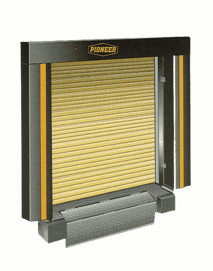 Dock seals are primarily about environmental control.
Consequently, they are best for facilities where maximizing that control matters. Temperature-controlled warehouses, like cold storage, use dock seals to preserve internal temperatures. Likewise, operations where pests are a threat, such as pharmaceutical and food storage, find dock seals reduce product loss.
Dock seals offer the following benefits:
- Tight seals. The union of the foam pads and the trailer makes a compression seal. These seals exclude most weather and debris.
- Energy efficiency. Tight seals prevent air exchange with the outside. This reduces the burden on your HVAC system. It doesn’t have to cool both the warehouse and the world every time the dock door opens, reducing your energy bill.
- Prevent contamination. Tight seals also prevent the intrusion of rain, wind, dust, and pests. This protects your products from contamination and keeps your docks clear of slipping and tripping hazards.
- Temperature stabilization. When the HVAC system isn’t fighting entropy, it can operate at peak efficiency. As a result, it maintains internal temperatures more easily. This prevents fluctuations caused by temperature loss, protecting your budget, staff, and products.
A good seal separates your loading dock from nature’s variables.
Dock Seal Trade-Off
Uniformity creates the best seals.
Once mounted, loading dock seals are not easily adjustable. Consequently, they function best with consistent trailer sizes. Size consistency ensures firm contact between the foam pads and the trailer, creating the tightest seal.
Trailers with different dimensions contact the pads at different spots. This may prevent a tight seal. It can also damage or prematurely wear out the pads.
Therefore, varying trailer sizes may affect your ROI.
Loading Dock Shelter
Picture an outdoor event tent.
The tent door rolls down, holding out wind and rain, but it’s not a perfect seal. Yet, its structure makes it versatile and adaptable. It accommodates all kinds of entryways, each with its own variations.
Dock shelters offer similar flexibility.
Essentially, dock shelters are a fabric curtain on a frame. They close on the back end of the trailer for protection, but leave the trailer doors free to swing open outside the building.
This allows easy access and rapid deployment.
When To Get a Loading Dock Door Shelter
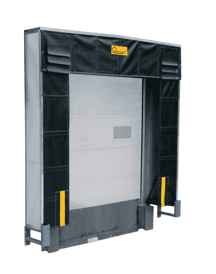 Dock shelters focus on versatility and weather protection.
Their comparatively simple design allows them to adapt rapidly to changing demands, like trailer variations. This makes them ideal for high-traffic docks where dock seals would cause unnecessary delays. Operations that value speed and flexibility over pest and debris protection are great candidates for dock shelters.
Dock shelters provide the following benefits:
- Varying trailer dimensions. The fabric curtain design easily adjusts to trailers with different heights and widths without any damage or loss of benefit.
- Reduced wear and tear. Backing alignment isn't as crucial with dock shelters, since trailers don’t have to connect snugly to fixed foam pads. Consequently, wear and tear is less of an issue with dock shelters.
- Full door access. Tight seals limit trailer door access. Fabric shelters adjust to keep trailer doors accessible.
- Weather protection. Even with their flexible curtain design, dock seals still exclude weather and most debris. This protects your products from weather damage and reduces slipping and tripping hazards on the dock.
A dock shelter’s versatility keeps out the elements without slowing you down.
Dock Shelter Trade-Off
Flexibility creates a softer seal.
Dock shelters do not create a compression seal. As such, they prevent less temperature loss than a dock seal. They won’t help insulate your facility as efficiently as a tighter seal. This can affect your power bill and your warehouse’s internal temperature stability. However, depending on your product, that may not be a concern.
They will keep out the heavy rain, strong wind, and storms that might otherwise complicate logistics and threaten your goods.
The Big Picture’s Bottom Line
Selecting the wrong option will tank your ROI.
So, it’s best to weigh your operational priorities.
- Dock seals are great for operations that value temperature control and have a uniform trailer fleet.
- Dock shelters are best for high-throughput facilities and mixed fleets.
Consider energy costs, productivity, environmental protection requirements, equipment lifespan, acceptable product loss, and any other important factors. Don’t focus on comfort. Both options improve comfort when used correctly.
Your loading dock isn’t just another door.
It’s how your warehouse connects to the outside world. The equipment you choose will affect how the external environment influences your internal environment.
Consider your options carefully and seek professional guidance.
Our dock and door experts have decades of experience evaluating commercial loading docks to provide the improvements that offer the best ROI. Our team will assess your dock and recommend ways to improve safety, boost productivity, and reduce product loss. With both Blue Giant and Nova dock seals and shelters at our disposal, we can supply whatever protection is best for you.
Don’t leave your dock exposed. Contact our dock and door team today.
To learn more about loading dock equipment, contact us online or visit one of our locations:
Arkansas - Jonesboro
Alabama - Birmingham, Dothan, Irondale, Madison, Mobile, and Montgomery
Georgia - Atlanta
Mississippi - Belden, Tupelo, and Richland
Tennessee - Jackson, Memphis, Knoxville, and Kingsport
Further Reading
5 Simple Ways to Improve Loading Dock Safety & Efficiency
How To Choose a Loading Dock Door
Dock Door Maintenance vs. Repair - Which One Costs Less?


Get The Right Forklift
Fill out the form to download the forklift buying guide.