



 Ken Lendermon
Your choice of warehouse packing equipment can help or hinder your success.
Thoughtful packing station designs prevent repetitive stress and improve productivity. Haphazard designs create bottlenecks and absenteeism. If you want to reduce injuries, associate turnover, and wasted time, your warehouse packing desks deserve your attention.
Read on to learn:
- How quality packing stations protect your team
- How thoughtful design elevates your productivity
- What things to consider when designing a warehouse packing station
Warehouse Packing Desk Benefits
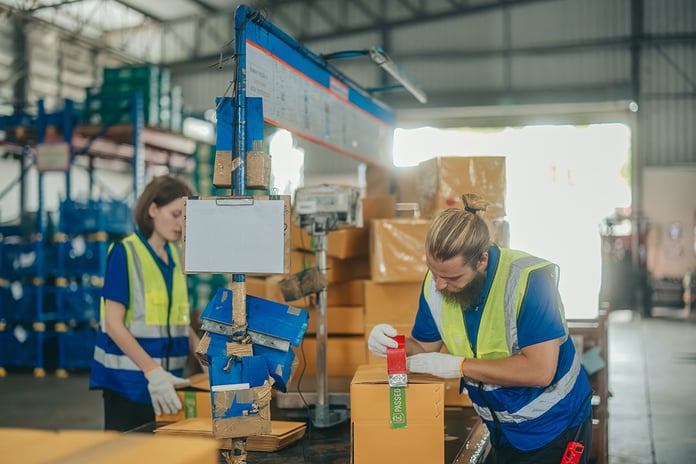
Warehouse layouts must prioritize your associates' needs.
When you put those needs first, you work with human behaviors rather than against them.
As a result, you avoid two significant pitfalls.
Associate Safety and Ergonomics
Warehouse workers are at higher risk of musculoskeletal disorders.
In 2018, the Bureau of Labor Statistics reported over 38,000 work-related musculoskeletal disorders in the transportation and warehousing industry. These injuries caused an average of 26 days away from work per occurrence.
Common causes included common activities, such as:
- Unsupported lifting
- Bending
- Twisting
Packing is highly repetitive. You can’t change the repetitive nature of the job, but you can reduce the stress it puts on the body.
Organizing and adjusting your packing stations to your body type reduces the movements that lead to injury.
Warehouse Workstation Productivity
Repetitive tasks build muscle memory.
Muscle memory reduces hesitation and errors. Consequently, it improves productivity. Your associates can’t build that muscle memory if each station layout is different.
Likewise, thoughtful layouts consider workflow.
A well-designed packing desk allows the packer to access frequently used tools with as little unnecessary movement as possible.
Example: A quality packing station might have a scale built into the working surface. That way, the packer doesn’t have to waste time transferring the carton to a separate scale before printing the shipping label.
Stations designed around consistency and process help your team work faster and waste less time.
Warehouse Packing Station Design Elements
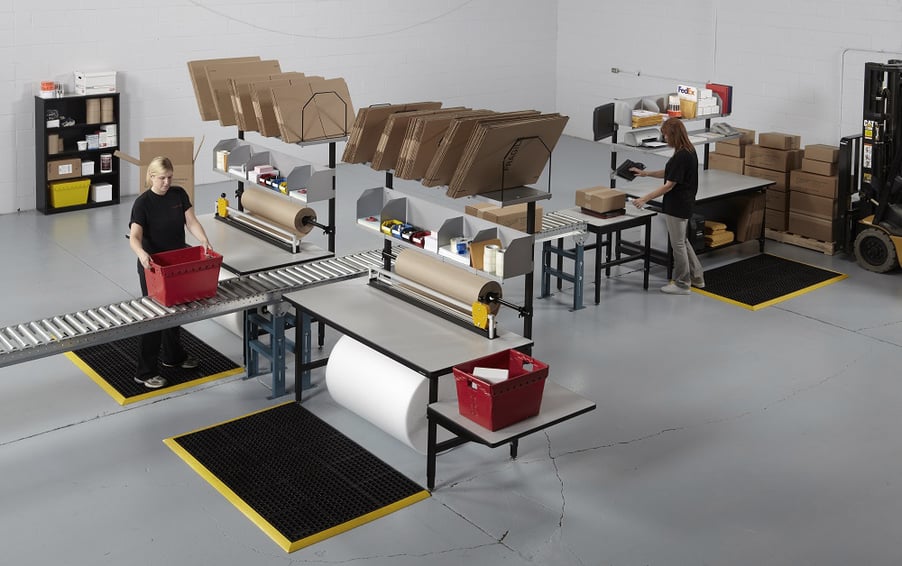 Each packing station is unique to the facility’s process.
However, quality designs all consider a few key elements. Each helps build an ergonomic work area.
Properly balancing these features for your unique workflow is critical for peak performance.
Work Surface
The work surface is the foundation of your station. Consider these factors when selecting the best packing desk for you:
- Adjustable height. Your associates come in all shapes and sizes. Your packing stations must adapt to each packer. Invest in an adjustable height packing table.
- Built-in shipping scales. As explained in the example above, a shipping scale can reduce unnecessary movement.
- Standardized tool placement. The most successful packing stations have a home for every tool. To accommodate this, your work surface needs enough space for all your packing equipment.
Digital Devices
Carpal tunnel and neck injuries happen as often at packing stations as in cubicles.
Where you place digital tools matters:
- Mount computer screens at eye level to avoid craning or overextending the neck.
- Place keyboards on sturdy typing trays with wrist rests for support.
- Install printers on a surface that lets the packer retrieve shipping labels without overreaching.
Like working surfaces, use adjustable mounts so each packer can customize their workstation.
Packing Material Storage
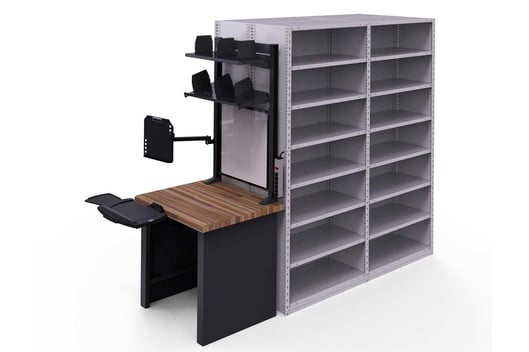
You’re wasting time if your most-used packing materials aren't within arm’s reach.
Invest in vertical storage options that stow materials at the rear of the station for easy access. Storage needs will depend on your shipping volume. At a minimum, each station should hold enough packing material to cover a full shift.
Restocking partway through the day wastes significant time. Avoid it whenever possible.
Material Movement
This is where workflow matters most.
Identify the steps a packer takes to process each shipment and consider questions like the following:
- Does product arrive at a lower height than the work surface?
- Does the packer have to turn to access products, equipment, or materials?
- What does a typical shipment weigh?
- What does the associate do with the shipment once packed?
Look for places where associates lift, bend, reach, and twist. Then consider ways to eliminate these movements.
Example: Lift tables can reduce the strain of lifting product. An assembly-style layout can prevent unnecessary twisting. A connected conveyor gives packers a convenient place to deposit ready-to-ship cartons.
Ideally, have a third party help you identify these areas for improvement. People who don’t engage with your packing process every day will notice different things than you and your team.
Warehouse Optimization Requires Custom Solutions
An optimized station is a customized station.
Without considering who uses a packing station and how they use it, you’re only getting in your own way.
That’s why we offer free warehouse optimization consultations.
With over a century of experience, we have seen every iteration of what works and what doesn’t. With your free optimization consultation, you get all that experience in one risk-free assessment. Our experts analyze nearly every aspect of your warehouse, identify areas for improvement, and pair them with actionable solutions.
Warehouse packing stations are one of the improvements that offer the fastest ROI, making them a great place to start.
Don’t let bad design slow you down. Schedule your free consult today.
To schedule your free warehouse optimization consultation, contact us online or visit one of our locations:
Arkansas - Jonesboro
Alabama - Birmingham, Dothan, Irondale, Madison, Mobile, and Montgomery
Georgia - Atlanta
Mississippi - Belden, Tupelo, and Richland
Tennessee - Jackson, Memphis, Knoxville, and Kingsport
Further Reading
8 Expensive Warehouse Design Mistakes
7 Easy Ergonomic Fixes to Make Employees More Productive
Material Handling Conveyor Systems 101


Get The Right Forklift
Fill out the form to download the forklift buying guide.